


In the fast-paced world of technology and digital transformation, we often look to Silicon Valley for our North Star. We study the "Move Fast and Break Things" mantra of SaaS giants and the sleek, software-defined elegance of Tesla. But a recent deep dive into the rise of BYD (Build Your Dreams) and its founder, Wang Chuanfu, has me rethinking the traditional playbook for innovation.
The documentary "The orphan that killed Tesla: Rise of BYD" isn't just a story about cars; it's a masterclass in resilience, vertical integration, and the raw power of "first principles" thinking. As an IT executive, I found the parallels between BYD's manufacturing journey and our modern DevOps and Infrastructure cycles to be nothing short of profound.
The Power of the "Underdog" Mindset
Wang Chuanfu's story starts in a place of extreme scarcity. Orphaned and raised in a poor village, his early life was defined by a need to maximize every available resource. When he founded BYD in the mid-90s, he didn't have the capital for high-end Japanese automation. His solution? He deconstructed the automated lines of Sony and Sanyo and rebuilt them as human-centric processes that were cheaper and more flexible.
In IT, we often fall into the trap of "Vendor Lock-in" or assuming that the most expensive enterprise tool is the only way to scale. BYD reminds us that innovation isn't about the tools you buy, but how you orchestrate your resources.
Vertical Integration: The Ultimate De-Risking Strategy
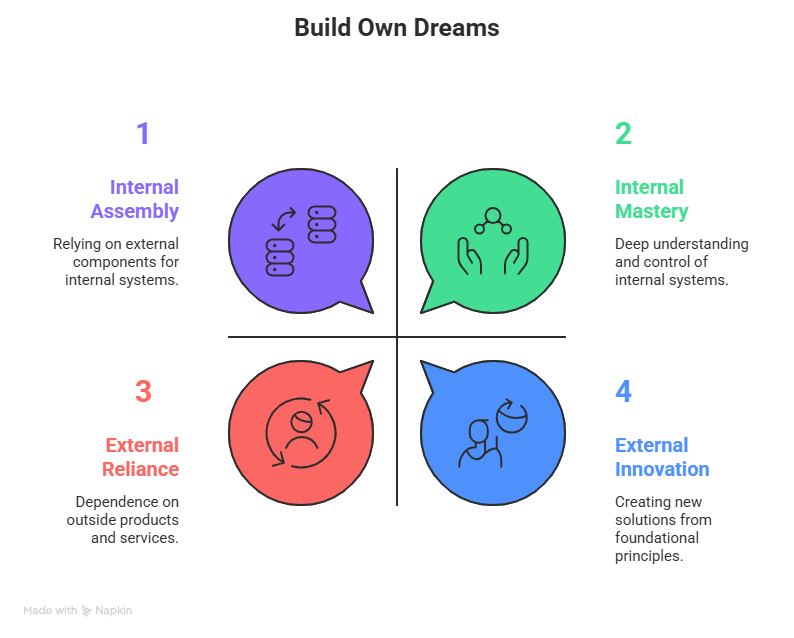
Perhaps the most striking takeaway is BYD's obsession with vertical integration. While most automakers act as "assemblers"—buying chips from one vendor and batteries from another—BYD builds almost everything in-house. They don't just make the car; they make the battery, the semiconductors, and the software.
We see this same trend in the tech world today. Why did Apple move to M-series chips? Why are AWS and Azure building their own ARM-based processors? Control over the stack equals control over the roadmap. When the global supply chain collapsed a few years ago, BYD kept rolling while others stalled because they owned their dependencies. For those of us in leadership, this reinforces the need to identify "critical path" technologies and ensure we aren't overly reliant on a fragile ecosystem of third-party APIs.
The "Blade Battery" Moment: Solving the Right Problem
For years, the EV industry was obsessed with range. BYD, however, pivoted to focus on safety and cost with their "Blade Battery" (Lithium Iron Phosphate or LFP technology). They realized that for mass adoption, consumers needed a battery that wouldn't catch fire and wouldn't break the bank.
This is a vital lesson in product-market fit. In IT, we often chase "shiny object" features—the latest AI buzzword or over-engineered microservices—when the business really just needs reliability, security, and uptime. BYD won not by being the "coolest" brand initially, but by being the most practical.
Business Takeaways for the Modern Leader
If we strip away the lithium and the chassis, what are the core business imperatives we can take back to our boardrooms?
- Resilience is a Competitive Advantage: Wang Chuanfu's ability to survive "The Darkest Moment" (2008-2012) was fueled by long-term vision. In business, your "technical debt" or "market lag" periods are inevitable. Survival depends on having a "North Star" that isn't tied to quarterly stock fluctuations.
- Democratize the Product: Tesla started top-down (Luxury to Mass Market). BYD started bottom-up and middle-out. There is massive value in the "unsexy" segments of the market. In IT, this means ensuring your internal tools empower the frontline workers, not just the executives.
- Mastery of the Fundamentals: You cannot innovate at the top of the stack if you don't understand the bottom. Wang's background in chemistry allowed him to revolutionize batteries. As leaders, we must stay close enough to the "code" or the "infrastructure" to know when a pivot is technically feasible.
Final Thoughts
The "Rise of BYD" isn't an indictment of Tesla, but rather a validation of a different kind of excellence. It proves that a disciplined, vertically integrated, and resource-efficient approach can take on the most well-funded incumbents in the world.
As we look at our own digital roadmaps for the coming year, let's ask ourselves: Are we just assembling pieces provided by others, or are we building something we truly own?
Thank You.
← Back to Blogs